
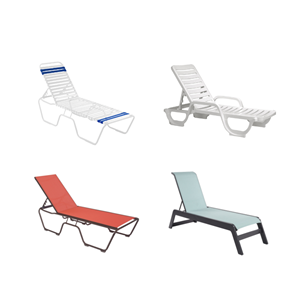
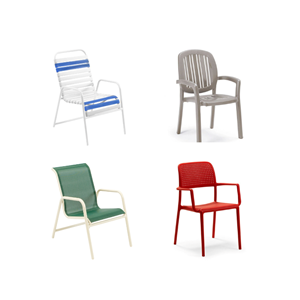
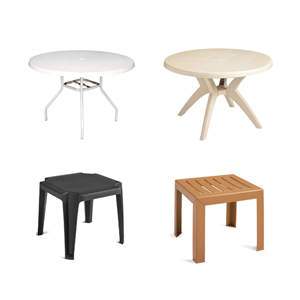
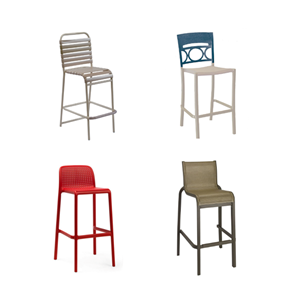

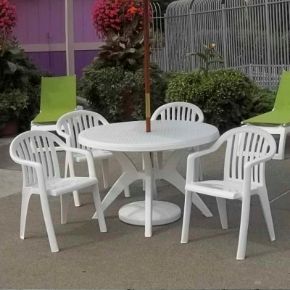
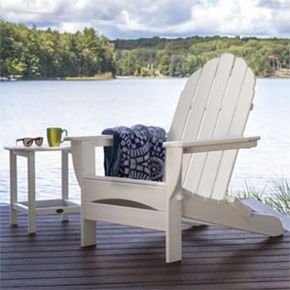
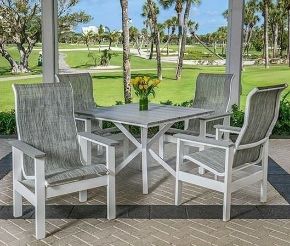
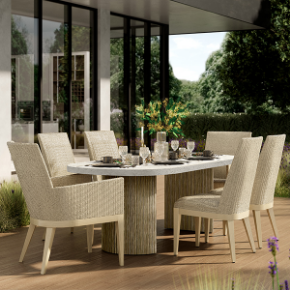
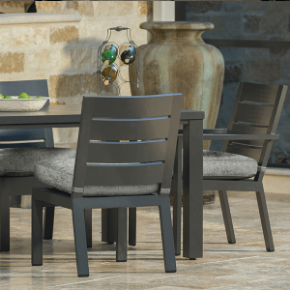
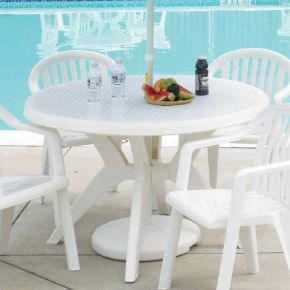
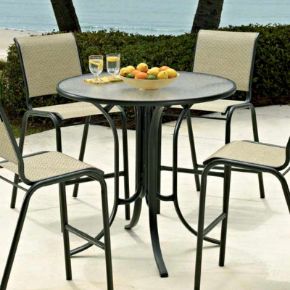
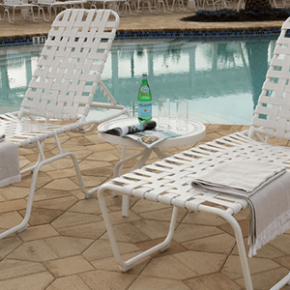




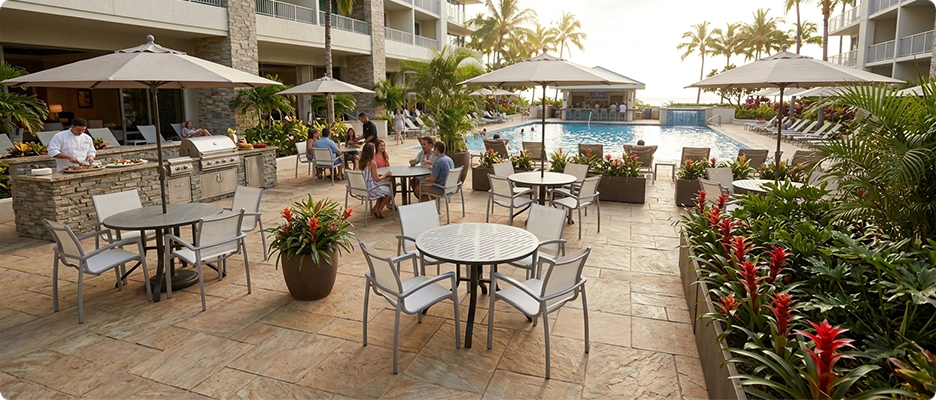
Choosing commercial poolside chairs involves more than selecting an attractive design. Chairs need to fit their intended spaces, work with existing tables, accommodate guests, and support the daily demands of a busy pool area.
An overlooked measurement or storage requirement can create unnecessary complications after delivery. Armrests may interfere with dining tables, chairs may occupy more floor space than expected, or cleaning requirements may not align with your facility's routine.
Whether you're furnishing a new pool deck or replacing an existing collection, this checklist will help you compare chair options, plan quantities, and prepare for a commercial furniture purchase.
Identify Your Facility's Seating Needs
Start by considering how the chairs will be used. A resort dining terrace, condominium pool deck, and community aquatic center may have different seating priorities.
| Consideration | What to evaluate |
|---|---|
| Seating purpose | Dining, casual seating, conversation areas, or multipurpose use |
| Environment | Sun exposure, pool-water splashing, coastal conditions, and shaded locations |
| Guest needs | Seat dimensions, arm support, comfort, and ease of entry and exit |
| Existing furniture | Compatibility with tables and surrounding furnishings |
| Daily operations | Cleaning frequency, furniture movement, and rearrangement |
| Storage | Available space for seasonal or temporary storage |
For properties with multiple seating areas, identify the needs of each location before deciding whether one chair style will work throughout the facility.
Compare Frame Materials and Seating Styles
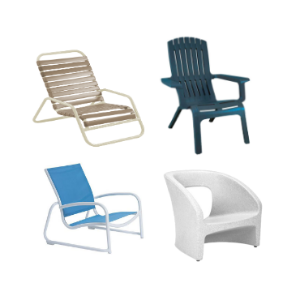
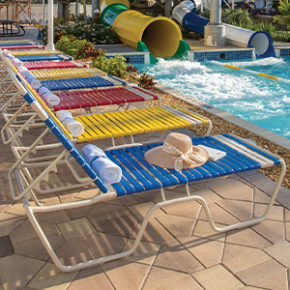
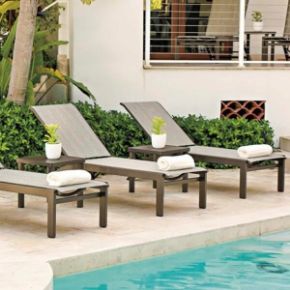
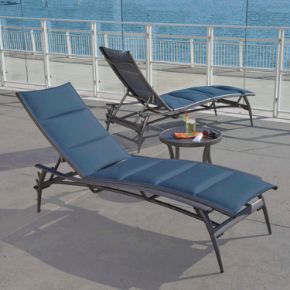
Commercial poolside chairs are available in a variety of materials and seating designs. Pool Furniture Supply offers options that include vinyl strap, sling, padded sling, plastic resin, recycled plastic, marine-grade polymer, woven, and cushioned seating.
Frame Materials
Frame construction influences a chair's weight, appearance, and maintenance considerations.
Depending on the collection, outdoor chairs may feature aluminum, resin, polymer, or other materials. Compare the frame construction, finish, weight, and available colors when narrowing your choices.
For properties near saltwater or exposed to frequent pool-water splashing, pay particular attention to the chair's construction and finish.
Seating Surfaces
Different seating styles offer distinct looks, support characteristics, and cleaning considerations.
| Seating style | Key considerations |
|---|---|
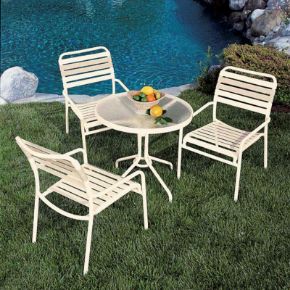
| Vinyl strap | Strap configuration, seating support, cleaning access, and replacement options |
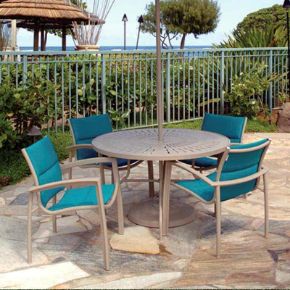
| Sling | Fabric construction, seating support, and replacement panels |
| Padded sling | Added cushioning, seating feel, and care requirements |
| Plastic resin | Molded construction, chair weight, and available designs |
| Recycled plastic | Construction, weight, and finish options |
| Marine-grade polymer | Construction, available styles, and intended applications |
| Woven or cushioned | Seating feel, cleaning needs, and cushion storage |
The goal isn't necessarily to find one material that's best for every facility. It's to select a chair that suits your environment, guest expectations, and maintenance routine.
For a more detailed comparison, read our guide to choosing the right seating material for commercial pool furniture.
Check Seat Height, Armrests, and Dining Table Fit
Chair dimensions are especially important when furnishing dining areas or replacing chairs around existing tables.
Two chairs may look similar but have different seat heights, armrest positions, and overall footprints. Those differences can affect both comfort and table compatibility.
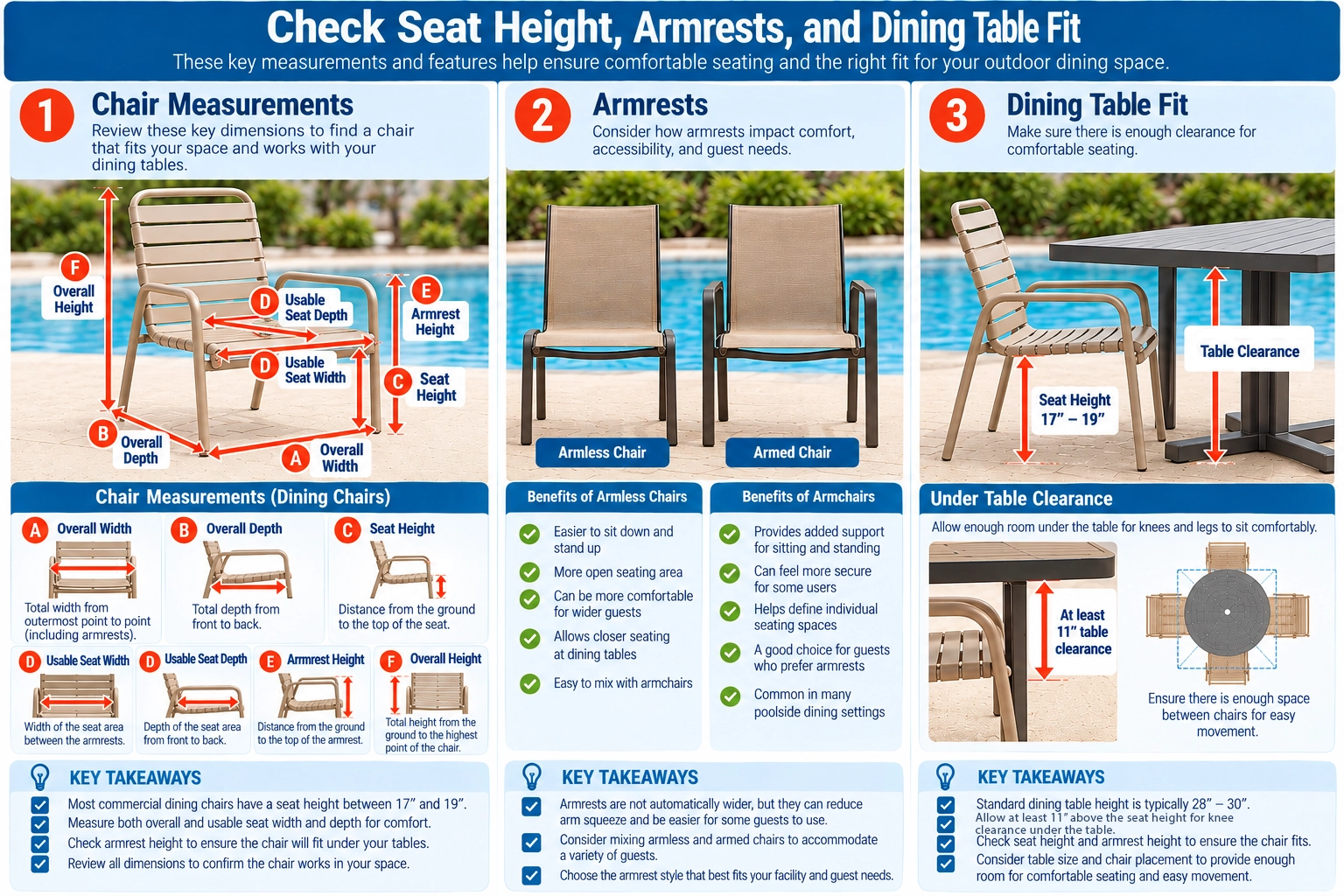
Which Chair Measurements Matter?
| Measurement | Why it matters |
|---|---|
| Overall width | Determines how much space the chair occupies |
| Overall depth | Helps plan seating arrangements and circulation |
| Seat height | Affects the seated position relative to a table |
| Usable seat width and depth | Helps evaluate seating room and comfort for different guests |
| Armrest height | Helps determine whether arms can slide beneath a table |
| Overall height | Identifies the chair's total profile |
Seat height and overall height are not interchangeable. A chair's backrest may make it appear taller without changing the position of the seat.
Will the Arms Fit Under Your Table?
For dining chairs with arms, compare the armrest height with the available clearance beneath the table.
- Measure the table clearance. Check the distance from the floor to the lowest obstruction beneath the tabletop, including aprons or supports.
- Compare armrest height. Determine whether the chair's arms can pass beneath that obstruction.
- Check the width. Make sure the chair fits between table legs or around the table base.
- Consider movement. Allow room for guests to pull out their chairs and move comfortably around the table.
Seat Width and Comfort for Different Guests
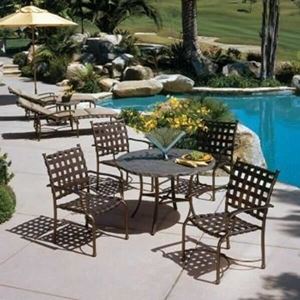
Seat width is an important consideration when selecting commercial poolside chairs for guests of different body sizes. On an armchair, the space between the armrests can be more restrictive than the chair’s overall width suggests.
Armless patio chairs can provide greater seating flexibility for wider guests. Without fixed armrests at either side, guests with wider hips are not confined between the arms and may be more comfortable with some room beyond the edges of the seat. The open-sided design can also make sitting down, standing up, or approaching the chair from the side easier for some guests.
Armchairs offer a different benefit: arm support that some guests find helpful when sitting down or standing up. Offering a mix of armchairs and armless chairs gives guests more choices without assuming one design suits everyone.
Compare usable seat width, seating support, overall dimensions, and the space around each chair. An armless chair is not necessarily wider, and its seating surface must still provide adequate support for the intended user.
Armchairs vs. Armless Chairs at Dining Tables
For dining layouts, armchairs require an additional clearance check beneath the tabletop. Armless chairs avoid that particular interference, but both styles must fit between table supports and leave room for guests to move comfortably.
When purchasing chairs and tables together, compare the dimensions of the specific models. If you're keeping existing tables, take their measurements before choosing replacement chairs.
Evaluate Stacking, Nesting, Folding, Weight, and Storage
Commercial poolside chairs may feature stacking, nesting, or folding designs that help facilities manage extra seating, rearrange dining areas, and prepare for seasonal storage. Each offers a different approach to reducing the space occupied by chairs when they're not in use.
Stacking vs. Nesting vs. Folding: What's the Difference?
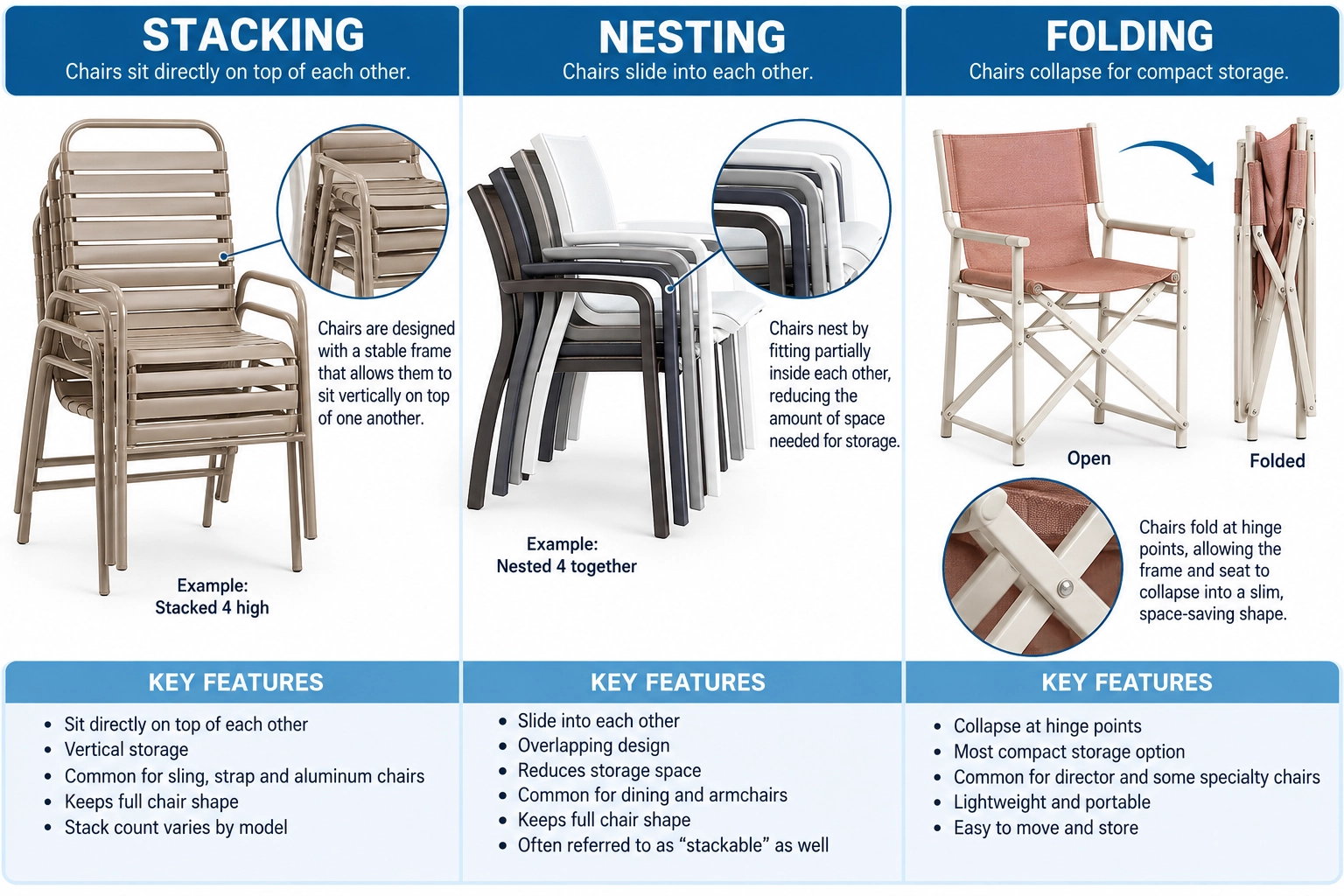
Stacking chairs are designed to fit vertically, with one chair resting above another. This allows multiple chairs to share a relatively small floor footprint while increasing the overall height of the stack. They're particularly useful for facilities that need to clear seating areas or store additional chairs.
Nesting chairs fit partially inside or overlap one another, forming a compact group. Depending on the design, chairs may nest vertically or horizontally. Their overlapping arrangement can reduce the space between chairs without necessarily creating a tall stack. Many patio chairs marketed as stackable can also be considered nested.
Folding chairs feature a frame or seat mechanism that allows the chair to collapse into a flatter profile when not in use. Folded chairs may be stored upright, side by side, or on suitable storage equipment, depending on their design. They're worth considering for facilities that frequently set up and remove temporary seating.
| Feature | Stacking | Nesting | Folding |
|---|---|---|---|
| Storage method | Placed vertically, one above another | Overlap or fit partially within one another | Collapse into a flatter configuration |
| Storage shape | Typically a taller stack | Compact, overlapping group | Folded units stored upright or grouped together |
| Space consideration | Stack height and footprint | Nested group dimensions | Folded thickness and storage arrangement |
| Handling | May require lifting chairs | Depends on nesting configuration | Requires folding and unfolding |
| Potential application | Seasonal storage and clearing seating areas | Grouping chairs in limited storage areas | Temporary seating and frequent setup changes |
No single storage design is automatically the most space-efficient. The best option depends on the chair's dimensions, the number of units being stored, and how frequently staff move the furniture.
What to Check Before Purchasing
- Whether the chair stacks, nests, folds, or has none of these features.
- How many chairs can be safely grouped or stored together.
- The overall dimensions of the stored configuration.
- The weight of each chair.
- How easily staff can move, separate, fold, or unfold the chairs.
- Whether carts, racks, or other storage equipment are needed.
For folding chairs, also consider the folding mechanism and whether the chair has a locking feature, if applicable.
Estimate Your Storage Space
Start with the number of chairs that will be stored simultaneously.
For stacking and nesting designs, determine how many chairs can be accommodated in each group. For folding chairs, calculate the space needed for the folded units based on their actual stored dimensions and arrangement.
Allow additional room for access, handling, and any required storage equipment. If chairs are moved frequently, their weight and ease of handling may be just as important as the amount of storage space they occupy.
Consider Cleaning, Maintenance, and Replacement Parts
Poolside chairs experience regular exposure to outdoor conditions, guest use, and routine cleaning. Choosing materials that fit your maintenance program can make daily operations easier.
Match Materials to Your Cleaning Routine
Consider how frequently chairs need to be cleaned, which surfaces collect debris, and whether the materials require special care.
For dining areas, look at how easily staff can reach seating surfaces and frame connections where food residue or dirt may accumulate.
If your facility uses specific cleaning products, confirm that they're appropriate for the selected frame and seating materials.
For more information about caring for strap seating, see our guide to cleaning vinyl strap pool furniture.
Plan for Future Repairs
Replacement components can be an important consideration for facilities maintaining large chair collections.
Depending on the design, you may want to ask about replacement straps, sling panels, cushions, glides, and hardware.
Also review warranty coverage, including what is covered and how claims are handled.
Considering these details before purchasing helps you understand the chair's ongoing maintenance needs.
Calculate the Right Chair Quantities
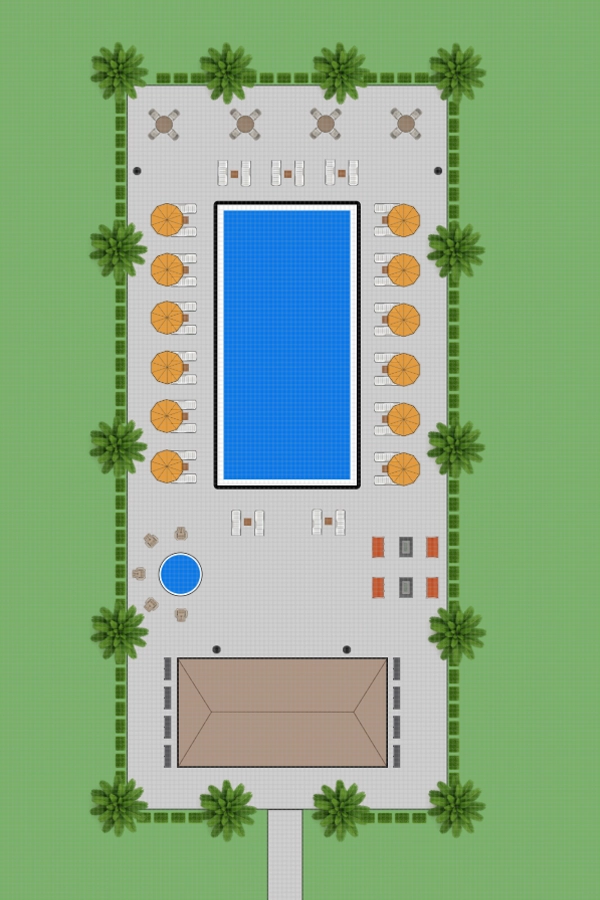
Start by dividing your facility into seating areas and determining how many chairs each location requires.
Dining Areas
For dining spaces, record the number of tables and the intended chairs per table.
Then check whether the proposed chair widths, armrests, and table bases allow that arrangement.
A table marketed for four guests may not comfortably accommodate four chairs of every design.
Other Poolside Seating
Include chairs used in conversation areas, shaded locations, and other designated seating spaces.
If you're replacing existing furniture, compare current quantities with the proposed layout. For new installations, consider furniture spacing, guest circulation, and accessibility needs.
Our article on planning pool deck layouts for better use of available space offers additional guidance.
Extra Inventory
If your property needs additional chairs for special events, replacements, or changing guest demand, list those separately from the primary seating quantities.
This also helps clarify storage requirements.
Commercial Poolside Chair Specification Checklist
Use this worksheet to compare chair models and organize the details needed for purchasing. On smaller screens, scroll the table horizontally to view both chair columns.
| Specification | Chair A | Chair B |
|---|---|---|
| Manufacturer / model / SKU | ________ | ________ |
| Intended seating area | ________ | ________ |
| Frame material and finish | ________ | ________ |
| Seating material | ________ | ________ |
| Overall width × depth × height | ________ | ________ |
| Seat height | ________ | ________ |
| Usable seat width and depth (between arms, if applicable) | ________ | ________ |
| Armrest height, if applicable | ________ | ________ |
| Intended table model | ________ | ________ |
| Table underside clearance | ________ | ________ |
| Table compatibility | ________ | ________ |
| Chair weight | ________ | ________ |
| Storage design (stacking / nesting / folding / none) | ________ | ________ |
| Maximum chairs per stack / nested group | ________ | ________ |
| Stored dimensions (stacked / nested / folded) | ________ | ________ |
| Cleaning requirements | ________ | ________ |
| Replacement parts | ________ | ________ |
| Warranty coverage | ________ | ________ |
| Frame and seating colors | ________ | ________ |
| Quantity needed | ________ | ________ |
| Price, lead time, and freight | ________ | ________ |
Use published product information and confirmed measurements to complete the worksheet. If a detail is unavailable, leave it marked for follow-up rather than estimating.
What to Include in Your Commercial Chair Quote Request
Once you've narrowed your selections, gather the information needed for pricing and order planning.
A complete request should include the chair models, quantities, colors, delivery location, and project timeline.
If the chairs will be used with existing tables, include their dimensions or model numbers. Mention any specific requirements involving seat height, armrests, stacking, nesting, folding, or storage.
Sample Quote Request
Facility: [Property name and location]
Project: [New installation, replacement, or expansion]
Chair model(s): [Manufacturer, model, and SKU]
Quantities: [Number required for each model]
Frame finish: [Preferred color]
Seating material/color: [Selected configuration]
Dining tables: [Existing table model or dimensions]
Special requirements: [Armrest clearance, seat height, stacking, nesting, folding, or storage]
Requested delivery: [Date or project timeframe]
Additional questions: [Pricing, freight, availability, warranty, replacement parts]
Organizing these details helps clarify your project requirements and reduces the need for follow-up questions during the quoting process.
Frequently Asked Questions
These common questions can help you narrow down commercial poolside chair options before requesting a quote.
Are armless poolside chairs a good choice for wider guests?
They can be. Without fixed armrests on either side, armless chairs allow more flexibility for guests with wider hips, who may otherwise feel confined between chair arms. They can also make it easier for some guests to sit down or stand up. Compare the actual seating surface, stability, and rated capacity of each model; an armless chair is not necessarily wider than an armchair.
Should a commercial pool area offer both armchairs and armless chairs?
Offering a mix can accommodate different comfort preferences. Armchairs provide a place to rest the arms and may help some guests when rising, while armless designs offer less restriction at the sides and can simplify side access. Check that both styles fit the intended dining tables and layout.
How can I tell whether a poolside chair will fit under my dining table?
Compare the chair's overall width and armrest height, if applicable, with the table's leg spacing and underside or apron clearance. Also allow space for guests to pull chairs out and move comfortably. Check the dimensions of the specific chair-and-table combination rather than assuming all dining-height furniture will fit together.
What is the difference between stacking, nesting, and folding chairs?
Stacking chairs are designed to sit vertically in groups. Nesting chairs overlap or fit partly into one another to reduce their storage footprint, sometimes in a horizontal arrangement. Folding chairs collapse into a flatter profile. Not every model supports these methods, so verify the manufacturer's stated storage configuration and limits for each product.
How many commercial poolside chairs should I order?
Start with the number of seats needed at each dining table, then count chairs for conversation areas and other seating zones. Check circulation space, table dimensions, storage capacity, and whether spare chairs are needed for your operating plan. Avoid estimating quantities from deck area alone.
Which chair details should I include when requesting a quote?
Include preferred models or SKUs, quantities, frame and seating colors, delivery location, project timing, and any requirements for seat width, armrests, table clearance, stacking, nesting, or folding. Existing table measurements are particularly helpful when chair compatibility is a priority.
Find Commercial Poolside Chairs for Your Facility
The right chair should complement your property's appearance while meeting its practical seating, maintenance, and storage needs.
By comparing materials, dimensions, table compatibility, and quantities before ordering, you can make a more informed purchasing decision.
Explore our selection of commercial poolside chairs to compare styles and identify options for your facility. Use the checklist above to organize your selections and prepare your commercial furniture quote.
Browse Commercial Poolside Chairs