













What's on This Page
- Why the Way You Operate a Cantilever Umbrella Matters
- Before You Open the Umbrella: Take 30 Seconds to Check It
- The Most Important Step: Loosen the Ribs Before Cranking
- If the Crank Resists, Don't Force It
- Use Tilt and Rotation Features Correctly
- Know When to Close the Umbrella
- How to Close and Fold the Canopy Correctly
- 7 Mistakes That Can Shorten the Life of a Cantilever Umbrella
- Create a Simple Routine for Commercial Properties
- Cleaning, Inspection & Seasonal Storage
- A Long-Lasting Cantilever Starts With the Right Umbrella and Foundation
- Frequently Asked Questions
Why the Way You Operate a Cantilever Umbrella Matters
A cantilever umbrella does more than simply open and close. Depending on the design, it may use a crank-operated lift system, adjustable tilt positions, a rotating mast, a large canopy, and a specialized base or mounting system.
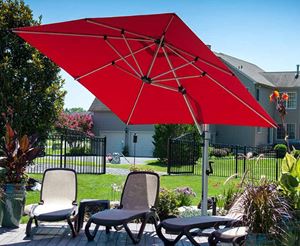
Those features are part of what makes commercial cantilever umbrellas so useful around pools, resorts, patios, and outdoor gathering spaces. With the support mast positioned off to the side, furniture can remain beneath the shaded area without a center pole interrupting the layout.
But the ribs, canopy, crank, and frame still have to work together every time the umbrella is opened, adjusted, and closed. Forcing one part of that system can transfer unnecessary stress to another.
Operating systems vary between cantilever models, so become familiar with the controls on your particular umbrella before putting it into regular service. Once you know how it is designed to move, the everyday routine is straightforward.
Before You Open the Umbrella: Take 30 Seconds to Check It
A quick visual check can prevent a small obstruction from becoming a damaged rib, torn canopy, or strained operating component.
- Check the weather. Avoid opening the umbrella when strong winds, sudden gusts, or approaching severe weather make shade unnecessary or unsafe to deploy.
- Look at the base or mounting system. Make sure the umbrella remains firmly secured and there is no obvious movement or loose hardware.
- Remove the cover and securing strap. Make sure nothing remains wrapped around the canopy or frame.
- Look at the folded canopy and ribs. Check for tangled fabric, crossed ribs, leaves, twigs, or anything else that could interfere with opening.
- Check the surrounding space. Make sure the canopy has room to open and rotate without contacting furniture, walls, railings, branches, overhead structures, or guests.
If you are still planning your shade area, our guide to matching the right umbrella with your outdoor application and layout explains how umbrella style, placement, traffic flow, and shade coverage work together.
The Most Important Step: Loosen the Ribs Before Cranking
One of the easiest cantilever care habits to overlook happens before you begin turning the crank.
After an umbrella has been fully closed, the ribs and canopy can settle tightly together. On some cantilever designs, attempting to immediately crank the umbrella open while everything is still tightly nested can create unnecessary resistance.
Before opening, look at the folded umbrella and gently loosen or separate ribs that have settled tightly together. Allow the folded canopy material to relax rather than expecting the crank mechanism to pull everything apart under tension.
Watch: How to Properly Open and Close a Cantilever Umbrella
Seeing the process can make proper cantilever operation easier to understand. The video below demonstrates how to prepare the ribs and canopy before opening and how to operate the umbrella without unnecessarily forcing the mechanism.
Do This
- Remove the securing strap completely.
- Look for tangled or trapped canopy fabric.
- Gently loosen tightly nested ribs.
- Begin cranking slowly and smoothly.
- Watch the canopy as the umbrella opens.
Avoid This
- Immediately cranking a tightly folded umbrella.
- Yanking a rib that does not move freely.
- Cranking faster when resistance increases.
- Ignoring fabric caught within the frame.
- Continuing to crank after the umbrella reaches its intended open position.
Once the ribs are free to move, open the umbrella slowly and steadily. Watch the canopy as it deploys. The ribs should move naturally while the fabric unfolds without becoming trapped between frame components.
If the Crank Resists, Don't Force It
It is easy to assume a stubborn umbrella simply needs more muscle. With a cantilever, that can be exactly the wrong response.
If the crank becomes unusually difficult to turn, stop. Look for crossed or tightly nested ribs, fabric caught in the frame, an obstruction, a control that has not been released, or another obvious reason the umbrella cannot move normally.
The same principle applies during closing. If the umbrella normally closes smoothly and suddenly does not, inspect it before continuing.
Use Tilt and Rotation Features Correctly
One of the biggest advantages of a cantilever umbrella is its ability to reposition shade without moving the base. Depending on the model, the canopy may rotate around the mast, tilt to different angles, or offer both adjustments.
Use the designated handles, cranks, locks, pedals, or other controls when changing the canopy position. Avoid using ribs or canopy supports as handles to pull the umbrella into position.
Before rotating the canopy, look around its entire path. An umbrella that clears a wall in one position may contact a railing, building, furniture grouping, tree, or other obstruction as it swings around the mast.
Know When to Close the Umbrella
Wind is one of the most important environmental factors affecting a large outdoor umbrella. The broad canopy that provides valuable shade also creates a substantial surface for wind to push against.
Some commercial cantilever umbrellas have published wind ratings, but those ratings should not be interpreted as a reason to leave an umbrella open regardless of conditions. Sudden gusts, wind direction, canopy angle, surrounding structures, elevation, mounting conditions, and other site factors can affect the forces placed on an umbrella.
Close and secure the umbrella when conditions become unsuitable, when severe weather approaches, or when the umbrella will not be needed for an extended period. Closing it when appropriate also reduces unnecessary exposure to everyday wind and weather.
Be particularly cautious when the canopy is tilted. Changing its angle also changes the way the umbrella meets the wind.
The umbrella's foundation matters just as much. Our article Make Safety a Priority: Properly Secure Your Umbrellas covers the importance of appropriate bases and mounting systems for commercial installations.
How to Close and Fold the Canopy Correctly
Proper closing is one of the most valuable things you can do for the canopy, yet it is easy to rush at the end of the day.
Close the umbrella smoothly while watching how the fabric settles between the ribs. Once the frame is fully collapsed, do not immediately wrap the securing strap around a bundle of crumpled fabric.
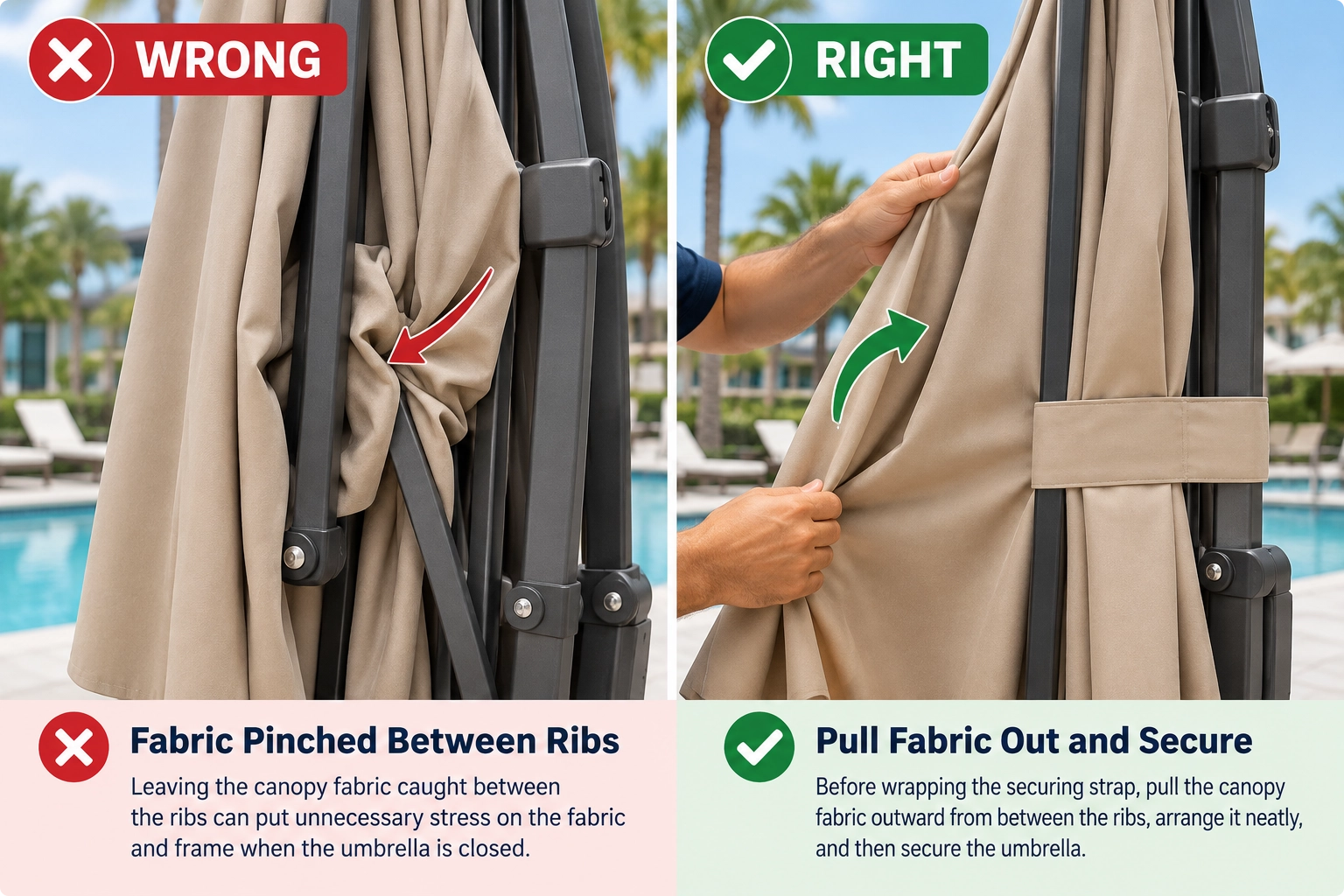
Instead, pull loose canopy panels outward from between the ribs and arrange the fabric neatly around the closed frame. This helps prevent folds of fabric from remaining tightly pinched against frame components while the umbrella is stored.
Once the canopy is neatly folded, secure it with the supplied strap. If your umbrella uses a protective cover, install it after the canopy has been properly arranged and secured.
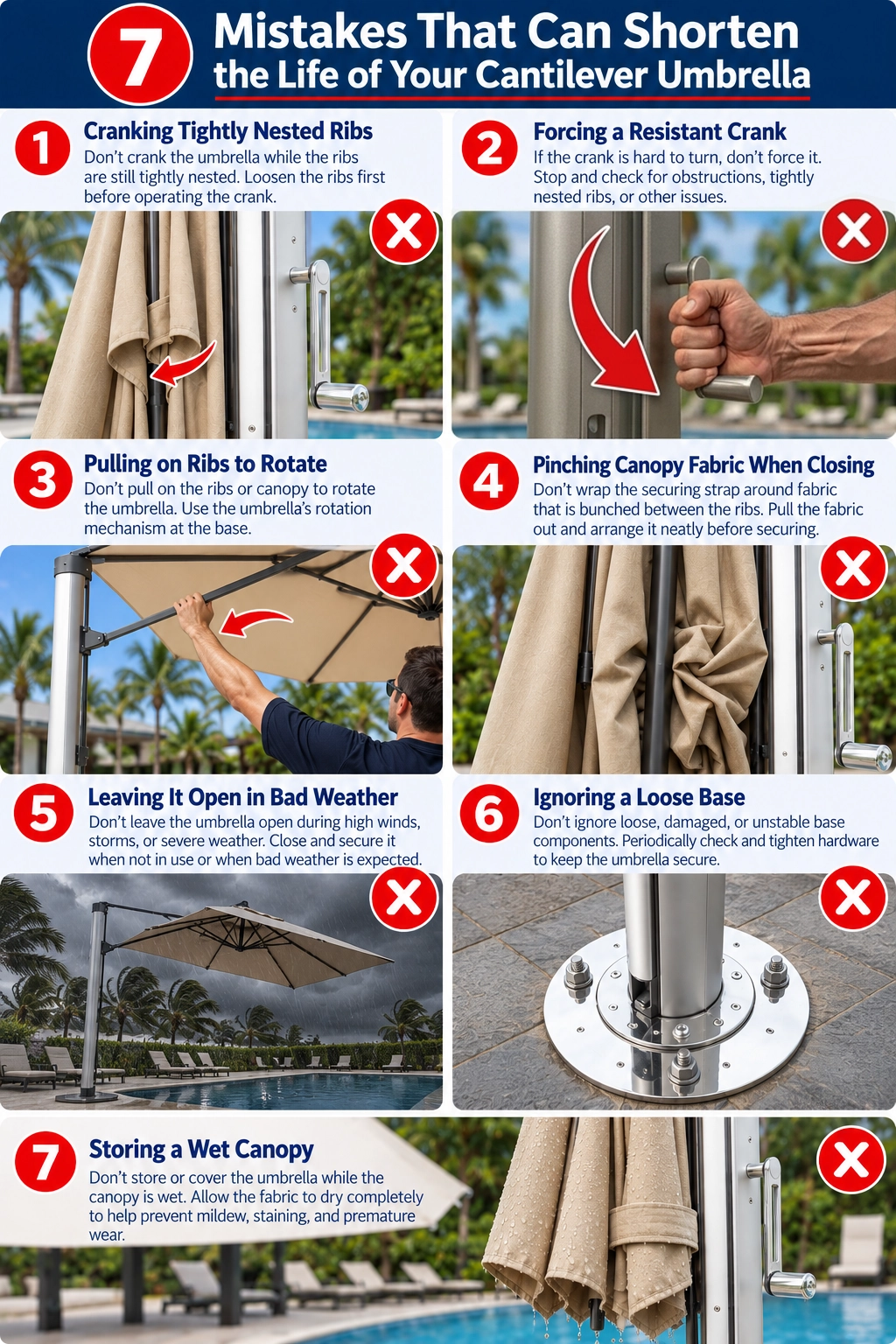
7 Mistakes That Can Shorten the Life of a Cantilever Umbrella
Many common cantilever umbrella problems can be avoided through careful everyday operation. The infographic below highlights seven mistakes that can place unnecessary stress on the canopy, ribs, crank system, frame, or mounting components.
Create a Simple Routine for Commercial Properties
At home, one person may operate the same umbrella every day. At a hotel, resort, HOA pool, apartment community, aquatic facility, or other commercial property, several employees may be responsible for opening and closing umbrellas throughout the week.
That makes consistency especially important.
For Hotels, Resorts & Commercial Pool Decks
Make sure employees responsible for outdoor setup know how each cantilever model operates. A short opening and closing routine can help prevent an unfamiliar staff member from forcing a crank, pulling on a rib, overlooking a loose mount, or strapping the canopy closed with fabric trapped between the frame.
A simple procedure does not have to be complicated. Staff can remember the basic sequence below:
A Simple Daily Cantilever Routine
Check the umbrella and weather. Loosen tightly folded ribs. Open it smoothly. Monitor weather conditions during use. Close without forcing the mechanism. Fold the canopy away from the ribs. Then secure the closed umbrella.
Cleaning, Inspection & Seasonal Storage
Correct operation does most of the day-to-day work, but occasional cleaning and inspection can help identify wear before it becomes a larger issue.
Quick Cantilever Umbrella Check
- Look for loose mounting hardware or movement at the base.
- Check ribs and frame components for visible damage or unusual alignment.
- Watch for canopy fabric that repeatedly catches or rubs against the frame.
- Look for small tears or worn areas before they grow larger.
- Make sure tilt and rotation controls engage normally.
- Pay attention to changes in how smoothly the crank operates.
- Remove accumulated leaves, dirt, salt, and other debris.
Keep the canopy clean and dry
Poolside umbrellas may be exposed to rain, chlorinated water, sunscreen residue, pollen, humidity, and airborne dirt. Coastal properties may also encounter salt deposits. Removing loose debris and periodically cleaning the canopy can keep buildup from becoming embedded in the fabric.
Use cleaning products and methods appropriate for your canopy material. Avoid unnecessarily aggressive scrubbing or cleaning methods that could damage outdoor fabric or its finish.
Before covering or storing the umbrella for an extended period, allow the canopy to dry thoroughly. If you need to close it while wet, reopen it when conditions permit so the fabric can dry before longer-term storage.
A Long-Lasting Cantilever Starts With the Right Umbrella and Foundation
Good operating habits cannot compensate for an umbrella that is wrong for the application or inadequately secured.
A cantilever supports its canopy from the side rather than from a pole directly beneath the center. That offset design creates valuable open space for lounge chairs, dining sets, conversation areas, and other furniture, but it also makes the base or mounting system an important part of the installation.
Use a base or mounting solution appropriate for the umbrella size and intended application. Installation requirements can vary depending on whether the umbrella is portable, surface mounted, or permanently installed.
If you are still comparing umbrella styles, sizes, fabrics, lift systems, and other features, our guide to making the best choice for your commercial umbrella is a helpful place to start.
For projects where the primary goal is increasing shade around or over the pool environment, you may also want to read about the cooling benefits of shade structures over pools.
And if your project calls for an umbrella positioned directly on a Baja shelf or sun ledge, that is a different application from a deck-mounted cantilever. Our guide to umbrellas designed for water-ledge use explains considerations for in-pool shade applications.
Frequently Asked Questions About Cantilever Umbrella Care
Should I loosen the ribs before opening a cantilever umbrella?
If the ribs have settled tightly together while the umbrella is closed, gently loosening them before cranking can help the frame begin opening without unnecessary resistance. Do not force apart a rib that appears stuck or damaged.
Why is my cantilever umbrella suddenly difficult to crank?
Stop operating it and look for an obstruction. Tightly nested or crossed ribs, trapped canopy fabric, debris, or a control that has not been released can interfere with normal movement. If there is no obvious cause, avoid forcing the mechanism until the problem can be identified.
Can a cantilever umbrella stay open when it isn't being used?
Closing and securing the umbrella when it is not needed reduces its exposure to wind, changing weather, and unattended conditions. This is particularly worthwhile overnight, during extended periods of non-use, or when weather conditions are uncertain.
Does a wind rating mean the umbrella can remain open up to that wind speed?
A published rating provides useful information about the umbrella, but real-world conditions are more complicated than a single number. Gusts, wind direction, canopy angle, installation, elevation, and nearby structures can all affect wind loads. Use weather conditions and the guidance for your particular umbrella when deciding when to close it.
Should a cantilever umbrella be covered when closed?
A protective cover can help reduce exposure during longer periods of non-use when one is provided or appropriate for the umbrella. Before covering it for an extended period, arrange the canopy properly and make sure the fabric is sufficiently clean and dry.
Small Habits Can Help Protect a Big Shade Investment
A commercial cantilever umbrella is a significant part of an outdoor space, and the way it is handled each day can make a difference in how well it performs over time.
Taking a few extra moments to loosen the ribs before opening, stop when the crank resists, monitor changing weather, fold the canopy neatly, and check the mounting system can help reduce unnecessary wear.

Planning a New Shade Area?
Explore commercial cantilever umbrellas from Pool Furniture Supply to compare sizes, canopy shapes, operating features, and mounting options for your outdoor space.
Explore Commercial Cantilever Umbrellas